
HEPCIDIN – UTILITY/FUNCTION
Human Iron Economy
Hepcidin is the master regulator of iron metabolism and plasma iron required to produce blood
• Plasma Iron is maintained normally at 10-30 µM
• Chronically >30 µM leads to iron deposition in tissues, injury, and organ damage
• Chronically <10 µM causes cellular dysfunction, and anemia
• Most iron is in the erythrocyte hemoglobin: 1 ml PRBC = 1mg fe
Hepcidin Potential Diagnostic Utility
• Hepcidin can diagnose iron deficiency in non-anemic patients
• Hepcidin can predict genetic disorders related to anemia (e.g. IRIDA)
• Hepcidin can predict non-responsiveness to oral iron
• Hepcidin can distinguish iron deficiency anemia (IDA) from anemia of chronic disease (ACD)
• Hepcidin measurement may improve the prediction of acute kidney injury (AKI) after heart surgery or in critical illness
• Hepcidin may predict mortality in critically ill patients with AKI
• Hepcidin may predict mortality in coronary artery disease
• Anemia defined by hepcidin is a risk factor for mortality post critical care discharge
• Hepcidin can predict iron deficiency in first-time blood donors
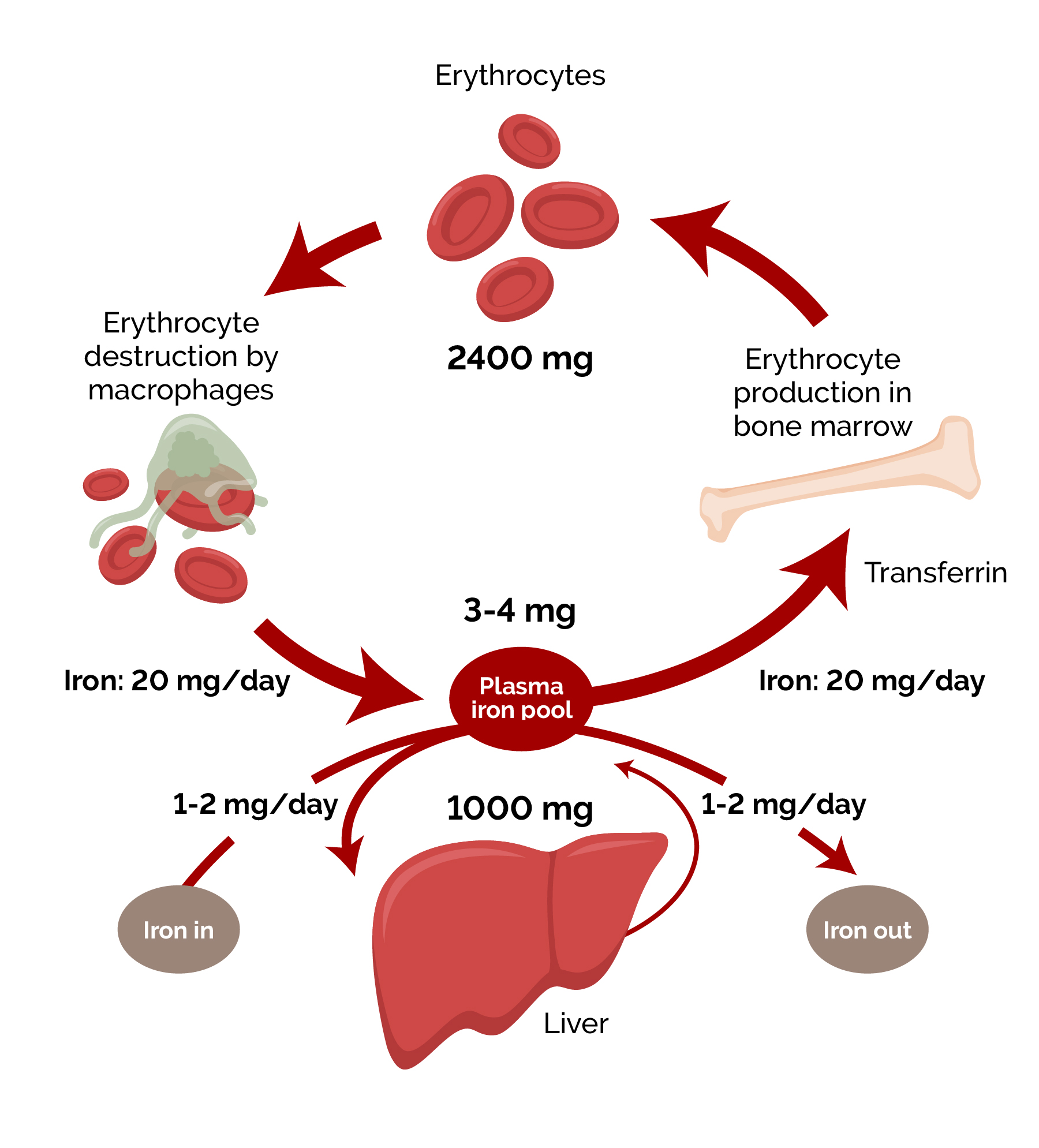
Hemochromatosis A New Look at an Old Disease.
N Engl J Med 2004; 350:2383-2397.
Serum hepcidin in various disease processes
| Disease | Pathophysiology | Hepcidin Level |
|---|---|---|
| Iron deficiency | Blood loss, malnutrition | Low/undetectable |
| Iron-refractory iron deficiency anemia | Genetic overproduction of hepcidin | High normal to high |
| Anemia of hepatic adenomas | Autonomous hepcidin production by tumor | High? (only tumor mRNA measured) |
| Hereditary hemochromatosis | Genetic hepcidin deficiency, varying severity | Undetectable, low, or low for iron load |
| Secondary iron overload | Transfusions, iron therapy | High |
| β-thalassemia intermedia (rare transfusions) | Ineffective erythropoiesis, high erythropoietic drive | Low |
| β-thalassemia major (regular transfusions) | Ineffective erythropoiesis, moderated erythropoietic drive, secondary iron overload | Low or low for iron load |
| Hepatitis C, alcoholic liver disease | Suppression of hepcidin by alcohol, virus or growth factors | Low |
| Infections, rheumatologic diseases, inflammatory bowel disease, cancer | Inflammation | High |
| Chronic kidney diseases | Decreased clearance of hepcidin, variable inflammation | High |
Adapted from T Ganz and E Nemeth. Hepcidin and Disorders of Iron Metabolism. 2011. Ann Rev Med 62: 347-360.
References
Serum hepcidin as a diagnostic test of iron deficiency in premenopausal female blood donors. Pasricha SR, McQuilten Z, Westerman M, Keller A, Nemeth E, Ganz T, Wood E. Haematologica 2011;96:1099-105.
Normalizing hepcidin predicts tmprss6 mutation status in patients with chronic iron deficiency. Heeney MM, Guo D, De Falco L, Campagna DR, Olbina G, Kao PP, et al. Blood 2018;132:448-52
Hepcidin levels predict non-responsiveness to oral iron therapy in patients with iron deficiency anemia. Bregman DB, Morris D, Koch TA, He A, Goodnough LT. American J Hematology 2012;88:97-101
Diagnostic accuracy of serum hepcidin for iron deficiency in critically ill patients with anemia. Lasocki S, Baron G, Driss F, Westerman M, Puy H, Boutron I, et al. Intensive care medicine 2010;36:1044-8
Urinary Biomarkers may Complement the Cleveland Score for Prediction of Adverse Kidney Events After Cardiac Surgery: A Pilot Study. Albert C, Haase M, Albert A, Kropf S, Bellomo R, Westphal S, Westerman M, Braun-Dullaeus RC, Haase-Fielitz A. Ann Lab Med. 2020 Mar;40(2):131-141
Iron, Hepcidin, and Death in Human AKI. Leaf DE, Rajapurkar M, Lele SS, Mukhopadhyay B, Boerger EAS, Mc Causland FR, Eisenga MF, Singh K, Babitt JL, Kellum JA, Palevsky PM, Christov M, Waikar SS. J Am Soc Nephrol. 2019 Mar;30(3):493-504
Iron Metabolism, Hepcidin, and Mortality (the Ludwigshafen Risk and Cardiovascular Health Study). Grammer TB, Scharnagl H, Dressel A, Kleber ME, Silbernagel G, Pilz S, Tomaschitz A, Koenig W, Mueller-Myhsok B, März W, Strnad P. Clin Chem. 2019 Jul;65(7):849-861
Iron deficiency diagnosed using hepcidin on critical care discharge is an independent risk factor for death and poor quality of life at one year: An observational prospective study on 1161 patients. Lasocki S, Lefebvre T, Mayeur C, Puy H, Mebazaa A, Gayat E. Crit Care 2018;22:314
Clinical Immunoassay for Human Hepcidin Predicts Iron Deficiency in First-Time Blood Donors. Gutschow P, Han H, Olbina G, Westerman K, Nemeth E, Ganz T, Copeland K, Westerman M, Ostland V. JALM 2020: 943-953